
Concrete Cleaning Without Etching the Surface
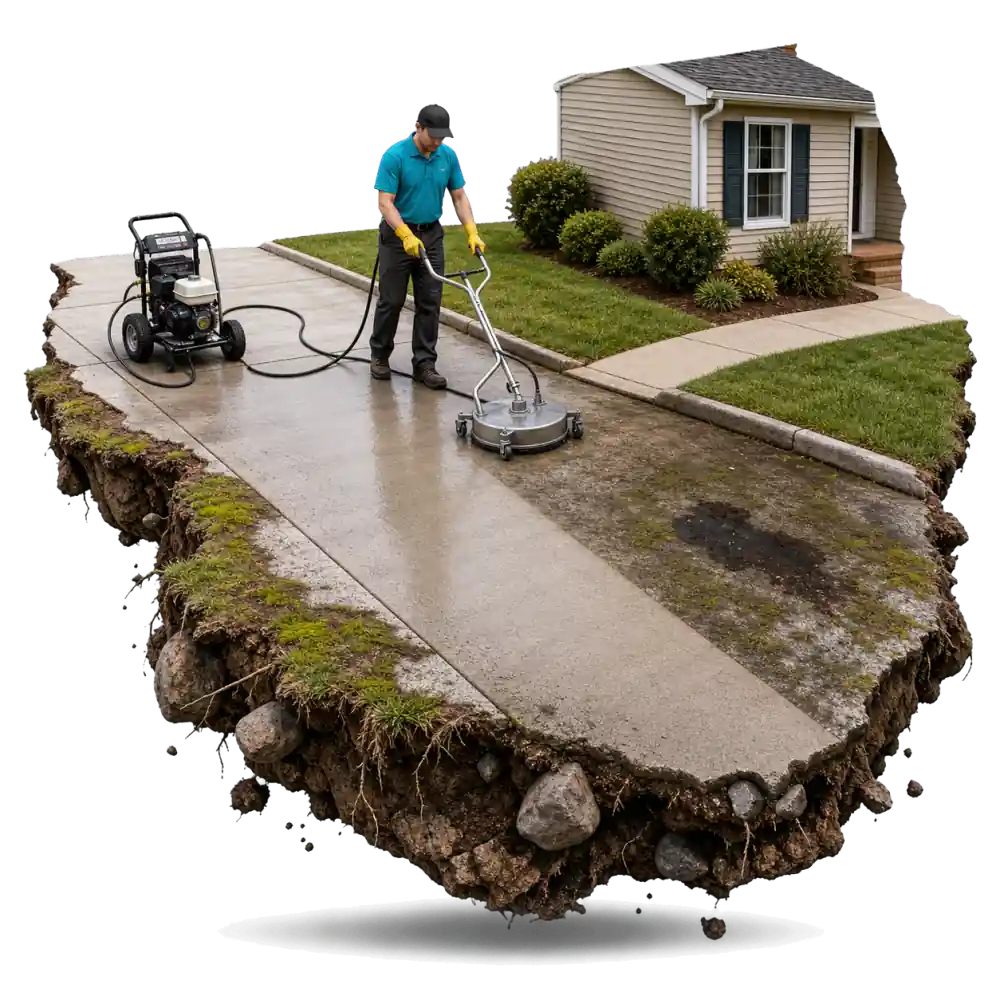
Concrete looks indestructible. It isn't. Hold a pressure washer too close, or too long in one spot, and you'll leave permanent wand marks — the striped, zebra-pattern etching you see on driveways all over Seattle, put there by someone who thought concrete couldn't be damaged. We clean driveways, sidewalks, patios, and garage floors at pressure the slab can take, with a surface cleaner that leaves no stripes at all.
- check_circle $0.20 per square foot
- check_circle Surface cleaner — no wand stripes
- check_circle Oil, moss, rust & tire marks
- check_circle Sealing available after cleaning
Driveway looking gray? We've often got a slot this week.
Send your address and we'll check availability and send a quote — usually within 1–2 hours during business hours. Same-day and next-day slots open up often.
- schedule Quote in 1–2 hrs
- event_available Same-day & next-day slots
- call Fast, no-pressure callback
Does Pressure Washing Damage Concrete?
It can, and it happens more often than people think. Concrete isn't one solid thing — it's aggregate held together by a thin, smooth layer of cement paste on top. That top layer is what you're looking at, and it's only a few millimeters thick.
Three ways concrete gets damaged:
- check_circle Etching. Too much pressure held in one place erodes the cement paste and exposes the sand and gravel underneath. The surface goes rough, holds dirt worse than before, and there is no way to undo it short of resurfacing.
- check_circle Wand stripes. A handheld wand cleans in an arc. Overlap it unevenly — which is nearly unavoidable by hand — and you get alternating light and dark bands. They don't wash out. They're etched in.
- check_circle Blown-out joints. On pavers and stamped concrete, a narrow jet strips the sand out of the joints. The pavers then shift and settle unevenly over the following winter.
What prevents all three: a surface cleaner — a rotating enclosed head that holds a fixed distance and sweeps evenly, so no square inch takes more pressure than any other. Plus the right PSI for the age of the slab. Taking over a new place and starting from scratch outside and in? See move-in cleaning for the interior.
Concrete cured less than a year is still gaining strength and needs less pressure. Old, spalling, or already-etched concrete needs less again. We look before we start.
When DIY Works, and When It Doesn't
Plenty of concrete cleaning is a perfectly reasonable weekend job. We'd rather tell you that than sell you something you don't need.
Do it yourself when:
- check_circle The area is small — a walkway, a set of front steps, a landing.
- check_circle The concrete is in good shape: no spalling, no existing etching, cured well over a year.
- check_circle It's general dirt and algae, not oil or rust.
- check_circle You can rent or borrow a surface cleaner attachment. This matters more than the machine.
What machine
For concrete you want 2,500–3,200 PSI and at least 2.5 GPM. Below that, you'll be there all day. Above 3,200 with a narrow tip, you're etching. But the honest answer is that flow matters more than pressure. A 3,000 PSI machine at 2.0 GPM cleans worse than a 2,500 PSI machine at 3.0 GPM, because what actually removes dirt is water volume moving across the surface. Most consumer machines from a big-box store are high PSI and low GPM — the exact wrong combination. And use a surface cleaner, not the wand. A $60 attachment is the single difference between a clean driveway and a striped one.
Call someone when:
- check_circle It's a full driveway. Hours of overlapping passes by hand, and stripes are almost certain.
- check_circle There's oil. Pressure alone spreads it. It needs a degreaser and dwell time.
- check_circle There's rust. Pressure sets it. It needs an oxalic acid treatment, and getting that wrong bleaches the concrete.
- check_circle The concrete is new, spalling, or already etched.
- check_circle It's a garage floor. Nowhere for the water to go, and everything you loosen flows toward the drywall.
How Much Does Concrete Cleaning Cost in Seattle?
We price concrete by area: $0.20 per square foot, with a $150 minimum visit.
- Driveway — 800 sq ft (40 × 20)from $180
- Long driveway — 1,200 sq ftfrom $275
- Patio — 200 sq ftfrom $75
- Sidewalk & walkways (per linear ft)from $2.10
- Garage floor — 400 sq ftfrom $150
- Oil stain treatment (per stain)from $40
- Rust treatment (per stain)from $55
- Sealing after cleaning (per sq ft)from $0.85
What moves the price: square footage, oil, rust, or paint, how long since the last cleaning, whether the slab drains or pools, and access for equipment.
Oil, Moss, and Rust: Three Different Problems
They all look like stains. They come off three completely different ways, and using the wrong one makes each of them worse.
Oil and transmission fluid. It soaked into the slab; it isn't sitting on top. Pressure alone drives it deeper and spreads the halo wider. It needs a degreaser, dwell time, and sometimes a poultice for old stains. Fresh oil comes out nearly completely. A ten-year-old stain under a car lightens substantially but rarely disappears — anyone who promises otherwise hasn't seen a ten-year-old stain.
Moss and algae. Seattle's specialty. Green on the north side, black in the shade, slippery in the wet. It comes off easily with pressure, but it comes back in a season unless it's treated — you have to kill the growth, not just remove what's visible.
Rust. From metal furniture, rebar, fertilizer, or well water. Pressure sets rust rather than removing it. It needs an oxalic acid treatment, and the risk is real: too strong and you bleach a pale patch into the concrete that's more obvious than the rust was.
Paint, tar, and battery acid each have their own answer. Tell us what it is and we'll tell you honestly what's achievable.
Surfaces We Clean
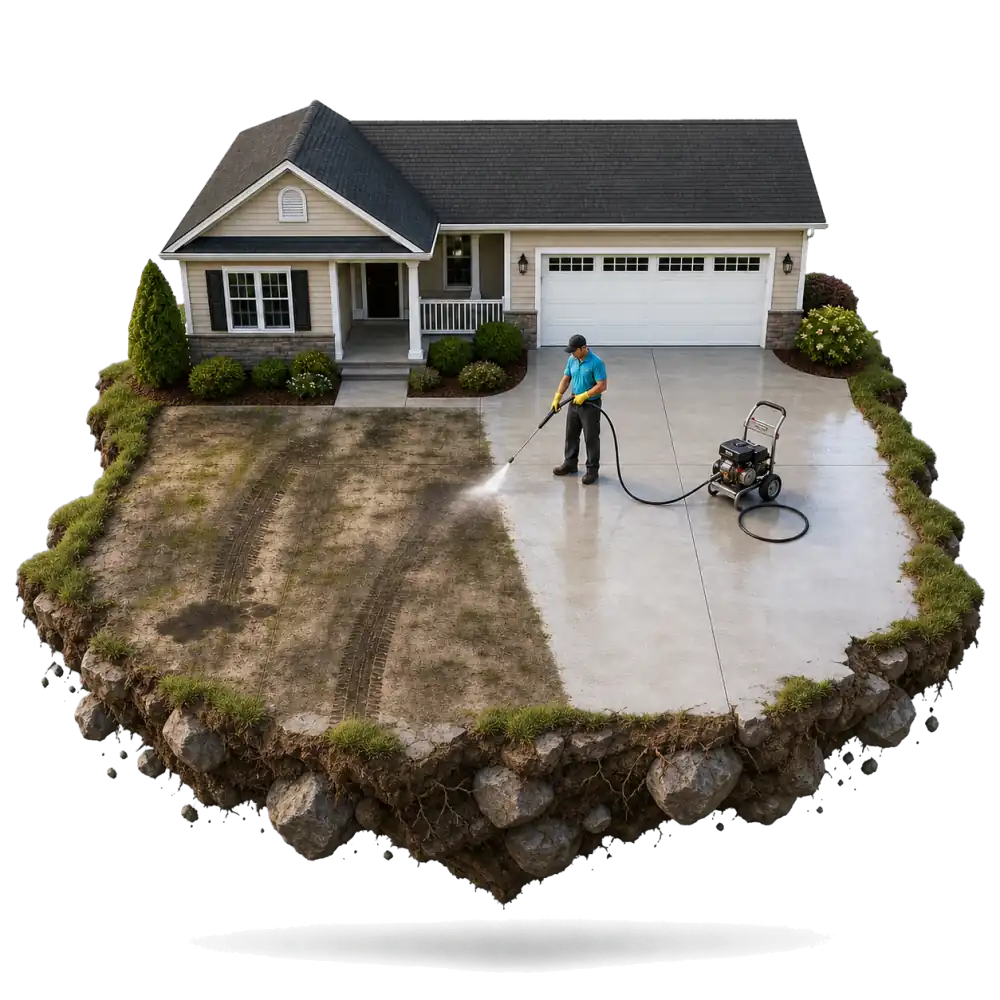
- check_circle Driveways — tire marks, oil, moss, and the gray film that hides how light the concrete actually is. More on driveway cleaning →
- check_circle Sidewalks and city strips — including the public sidewalk in front of your house, which in Seattle is the homeowner's responsibility to maintain.
- check_circle Walkways and garden paths — usually the mossiest, slipperiest concrete on the property, and the one people actually walk on.
- check_circle Front steps and landings — the first thing a guest, buyer, or inspector sees.
- check_circle Garage floors — oil, tire marks, road salt. Water management matters more than pressure here.
- check_circle Patios and pavers — including joint re-sanding when needed.
- check_circle Parking pads and garage approaches — where oil collects.
- check_circle Trash bin areas — the one nobody wants to think about, and the one that most changes how a side yard smells.
Sealing After Cleaning
Clean concrete is porous concrete. In Seattle, that means it starts absorbing water again the moment we leave.
A penetrating sealer soaks into the slab and dramatically slows what causes most of the damage: water getting in, freezing in January, and spalling the surface off in flakes. It also makes the next oil spill wipe up instead of soaking in, and buys you a year or two before the moss returns.
Sealing only works on properly cleaned, fully dry concrete — sealing over dirt locks the dirt in permanently. That's why it's a service that has to follow a cleaning, never replace one.
From $0.85 per square foot, applied 24–48 dry hours after cleaning.
Concrete Cleaning FAQ
Does pressure washing damage concrete? expand_more
Is pressure washing bad for concrete? expand_more
What type of pressure washer do you need for concrete? expand_more
Should I pressure wash my own concrete? expand_more
How much does concrete cleaning cost in Seattle? expand_more
Can you remove oil stains from a driveway? expand_more
Will the moss come back? expand_more
Should I seal my concrete after cleaning? expand_more
Do you clean the sidewalk in front of my house? expand_more
Not Sure Which Category You're In?
If it's a small walkway and general dirt, rent a surface cleaner and enjoy your Saturday. We mean that. If it's a driveway, a garage floor, oil, rust, or concrete you're not sure about — send us a photo. We'll tell you what it actually needs, including if the answer is "not much."
Licensed & insured · Seattle & the Eastside · Surface cleaner, no wand stripes
More Pressure Washing in Seattle
Every exterior surface, matched to the right method. Swipe to explore the rest.
Need the inside done too? We also offer house cleaning in Seattle, deep cleaning, and move-out cleaning.